

Maybe your ankle started hurting after a twist you thought was minor. Maybe it hurts every time you walk. Or perhaps the pain appeared gradually and you cannot remember injuring it at all.
There are many possible causes of ankle pain. The location of the pain, what brings it on, and whether it is getting better or worse can all provide useful clues.
The important question is not just “Why does my ankle hurt?” but also “Is this something that should be evaluated?”
What Can Cause Ankle Pain?
Your ankle contains bones, cartilage, ligaments, tendons and nerves that all work together every time you stand, walk or push off the ground.
Common causes of ankle pain include:
Ankle Sprains
A sprain occurs when one or more of the ligaments supporting the ankle are stretched or torn.
Most sprains improve with appropriate care, but pain, swelling or instability can sometimes linger—especially if the injury was more significant than it first appeared.
Chronic Ankle Instability
Does your ankle repeatedly feel like it wants to roll or “give way”?
After a significant or repeated sprain, the ankle may not regain its previous stability. Weakness and loss of balance can contribute as well.
Tendon Problems
Several important tendons cross the ankle.
Pain at the back may involve the Achilles tendon. Pain along the outside can involve the peroneal tendons, while pain along the inside may involve the posterior tibial tendon.
Overuse, activity changes and foot alignment can all place additional stress on these structures.
Ankle Arthritis
Arthritis can cause aching, swelling, stiffness and reduced movement.
Ankle osteoarthritis frequently develops after a previous injury such as a fracture or significant sprain. Gout and inflammatory arthritis can also affect the ankle.
Ankle Impingement
Impingement occurs when tissue becomes pinched around or inside the ankle joint.
Scar tissue, inflamed tissue or bone spurs may cause pain, particularly when squatting, climbing stairs or bending the ankle.
Cartilage Injuries
An ankle injury can sometimes damage the cartilage inside the joint and the bone beneath it.
One example is an osteochondral lesion of the talus, which can occur with an ankle sprain.
Symptoms may include deep ankle pain, swelling, clicking, catching or a sensation that something is stuck inside the joint.
Stress Injuries and Overuse
Not every ankle injury happens suddenly.
Running, walking, sports or a significant increase in activity can sometimes lead to stress injuries, tendon irritation or other overuse problems.
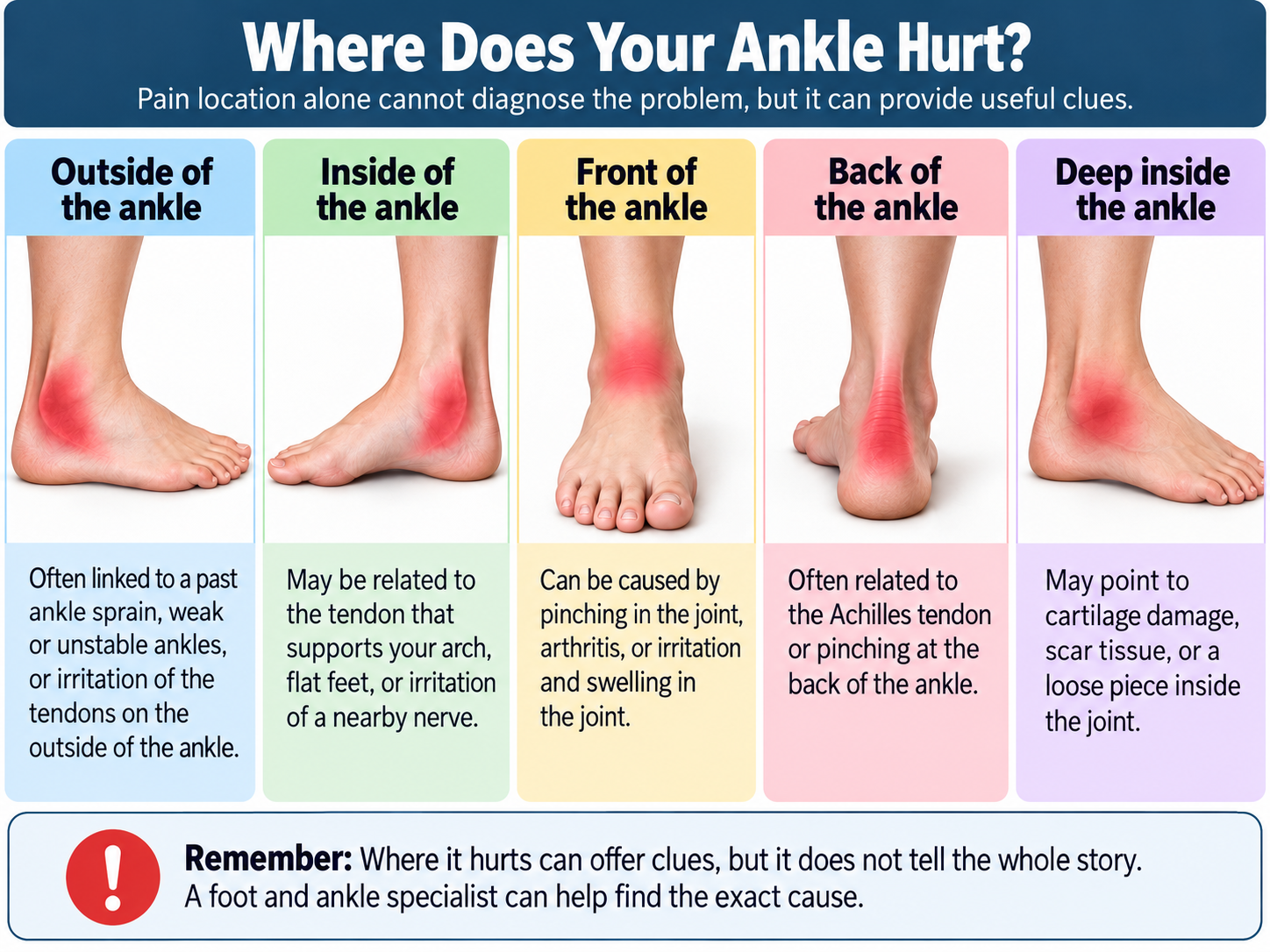
Where Does Your Ankle Hurt?
Pain location alone cannot diagnose the problem, but it can provide useful clues.
Outside of the ankle: Previous sprain, chronic instability or peroneal tendon problems.
Inside of the ankle: Posterior tibial tendon problems, flat feet or nerve irritation.
Front of the ankle: Impingement, arthritis or joint inflammation.
Back of the ankle: Achilles tendon problems or posterior impingement.
Deep inside the ankle: Cartilage injury, scar tissue or loose fragments within the joint.
Why Does My Ankle Hurt When I Walk?
Walking repeatedly asks your ankle to support your body weight, move forward and push off the ground.
If a tendon, ligament, bone or part of the joint is irritated, pain may become more noticeable during that process.
Pay attention to the pattern.
Does it hurt with every step?
Only after you have been walking for a while?
On stairs or hills?
Does it swell afterward?
Does the ankle feel unstable?
Those details can help identify which structures may need closer examination.
Why Does My Ankle Still Hurt After a Sprain?
A sprain can involve more than temporary swelling around a stretched ligament.
Persistent pain after a sprain may be related to:
- incomplete ligament recovery,
- chronic ankle instability,
- tendon injury,
- scar tissue or impingement,
- cartilage damage,
- an osteochondral lesion, or
- another injury that was not obvious at first.
An ankle that continues to hurt, swell, give way or catch after a sprain deserves another look.
That does not automatically mean surgery.
It means it may be time to determine whether something besides the original sprain is causing the symptoms.
What Causes Ankle Pain Without an Injury?
Ankle pain does not always begin with a fall or memorable twist.
Gradually developing pain may come from:
- repetitive activity,
- tendon irritation,
- arthritis,
- flat feet or other alignment issues,
- stress injuries,
- gout or inflammatory conditions, or
- nerve irritation.
Think about what changed before the pain began. A new exercise program, increased walking, different shoes or more time standing can all be useful clues.
What Can You Do About Ankle Pain?
For mild ankle discomfort, temporarily reducing the activity that aggravates the ankle may help.
Depending on the cause, treatment might eventually include:
- activity modification,
- physical therapy,
- balance and strengthening exercises,
- bracing,
- supportive footwear,
- orthotics,
- medication when appropriate, or
- selected injections.
The right treatment depends on what is actually causing the pain.
Repeatedly trying to “push through” ankle pain without understanding the cause can sometimes prolong the problem.
When Should You Worry About Ankle Pain?
Consider having your ankle evaluated when:
- pain is not steadily improving,
- symptoms keep returning,
- the ankle repeatedly swells,
- it feels unstable or gives way,
- walking is becoming more difficult,
- you have catching or locking,
- pain repeatedly returns after activity, or
- the ankle never returned to normal after an injury.
More urgent evaluation may be appropriate after an injury if you cannot bear weight, there is significant swelling or deformity, or there are signs of infection.
How Is Persistent Ankle Pain Diagnosed?
An evaluation usually begins with how the pain started, where it hurts and what makes it worse.
Your provider may examine ankle motion, ligament stability, tendon strength, alignment, swelling and your walking pattern.
For persistent ankle pain, X-rays are often the first imaging study.
An MRI, CT scan or ultrasound may be considered if the examination suggests a cartilage, tendon, ligament or other structural problem that cannot be fully evaluated on an X-ray.
Not every painful ankle needs an MRI.
The goal is to use imaging to answer a specific question.
What If Ankle Pain Does Not Improve?
If appropriate conservative treatment has not solved the problem, the next question should not automatically be:
“What surgery do I need?”
A better question is:
“Why is this ankle still hurting?”
Sometimes further evaluation identifies a problem inside the ankle joint, such as damaged cartilage, impingement, scar tissue or a loose fragment.
For certain problems like these, ankle arthroscopy may be one treatment option.
What Is Ankle Arthroscopy?
Ankle arthroscopy is a minimally invasive procedure that allows a surgeon to look directly inside the ankle joint through small incisions.
A small camera provides a view of the joint, and specialized instruments can be used to treat certain problems.
Arthroscopy may be considered for selected conditions including:
- certain types of ankle impingement,
- some cartilage or osteochondral injuries,
- loose pieces of cartilage or bone,
- painful scar or inflamed tissue, and
- selected cases involving ankle instability.
But ankle arthroscopy is a technique, not a diagnosis.
Simply having ankle pain for several months does not make someone a candidate.
Persistent Ankle Pain? Start With the Diagnosis
An ankle that keeps hurting does not automatically mean something serious is wrong—and it does not automatically mean surgery.
But persistent pain, recurring swelling, instability, catching or locking are worth understanding, especially when they begin limiting what you can do.
At Feet for Life Podiatry Centers, our St. Louis and Chesterfield foot and ankle specialists evaluate acute and persistent ankle problems and recommend treatment based on the underlying cause.
Some patients may need rehabilitation and better support. Others with specific problems inside the ankle joint may benefit from minimally invasive treatment.
The goal is not to find a surgery for ankle pain. It is to find out why your ankle hurts and choose the treatment that fits the problem.
Still Dealing With Ankle Pain?
If ankle pain keeps returning, is not improving or is limiting your normal activities,
This information is intended for general education and does not replace an individual medical evaluation.


