

 collapse
Find relief for curled, bent, or painful toes with Feet For Life
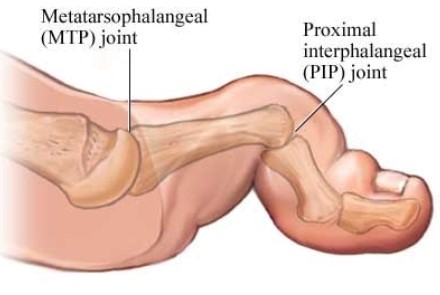
A hammertoe is a deformity where one of the toe joints bends abnormally, causing the toe to curl downward instead of lying flat. Over time, this imbalance places pressure on the top of the toe, the ball of the foot, and inside shoes — leading to pain, corns, calluses, and difficulty wearing certain footwear.
Hammertoes can involve one or multiple toes and may be flexible (still able to move) or rigid (stiff and fixed). Early treatment often prevents the deformity from getting worse.
About Hammertoes and Diagnostics
Why Hammertoes Develop
A bent toe typically occurs due to an imbalance in the tendons, muscles, or joint structures that keep the toe straight. Common contributors include:
- Foot structure (flat feet, high arches, long toes)
- Bunions or crowding of the toes
- Tight or narrow shoes
- Previous injury
- Arthritis or age-related joint changes
- Tendon tightening over time
When these forces shift, the toe begins to buckle, creating the curled appearance.

 Common Symptoms
You may be experiencing a hammertoe if you notice:
- A visible bend or curl in a toe
- Pain when wearing shoes
- Corns or calluses on the top or tip of the toe
- Soreness under the ball of the foot
- Increasing stiffness or limited movement
- Toe rubbing or pressure inside shoes
If untreated, hammertoes often become more rigid and more painful.
How We Diagnose Hammertoes
At Feet for Life Podiatry Centers, we evaluate:
- Toe alignment and joint flexibility
- Gait and foot mechanics
- Footwear and pressure points
- Any related issues such as bunions, flat feet, or tendon imbalances
- X-rays if needed to assess joint changes
This allows us to determine the stage of the deformity and the best treatment approach.
Complications
Frequently, hammertoes develop corns on the top of the toe as a result of rubbing on the shoe. They may also cause a bothersome callous on the ball of the foot. This occurs as a result of the toe pressing downward on the bone behind the toe. This area then becomes prominent and the pressure of the bone against the ground causes a callous to form.
They tend to slowly get worse with time and frequently flexible deformities become rigid. Treatment can be preventative, symptomatic or curative.

Hammertoe Treatment
Treatment Approaches
Preventative treatment
Preventative treatment of hammertoe is directed toward the cause of the deformity. A functional orthotic is a special insert that can be prescribed by your podiatrist to address the abnormal functioning of the foot that causes the hammertoe. Functional orthotics can be thought of as contact lenses for your feet. They correct a number of foot problems that are caused by an abnormally functioning foot. Our feet, much like our eyes, change with time. Functional orthotics slow down or halt this gradual change in the foot. Often when orthotics are used for flexible hammertoes, the toes will overtime straighten out and correct themselves. Calf stretching exercises are also helpful. Calf stretching can help to overcome part of the muscle imbalance that causes the hammertoe.
Symptomatic Treatment
Symptomatic treatment of hammertoes consists of such things as open toed shoes or hammertoe pads. There are over the counter corn removers for temporally reducing the painful callous often seen with the hammertoe. These medications must be used with caution. They are a mild acid that burns the callous off. These medications should never be used for corns or callouses between the toes. Persons with diabetes or bad circulation should never use these products.
Curative Treatment
Curative treatment of hammertoes varies depending upon the severity of the deformity. When the hammertoe is flexible, a simple tendon release in the toe works well. The recovery is rapid often requiring nothing more that a single stitch and a Band-Aid. Of course if several toes are done at the same time, the recovery make take a bit longer. For the surgical correction of a rigid hammertoe, the surgical procedure consists of removing the damaged skin where the corn is located. Then a small section of bone is removed at the level of the rigid joint. The sutures remain in place for approximately ten days. During this period of time it is important to keep the area dry. Most surgeons prefer to leave the bandage in place until the patient’s follow-up visit, so there is no need for the patient to change the bandages at home. The patient is returned to a stiff-soled walking shoe in about two weeks. It is important to try and stay off the foot as much as possible during this time. Excessive swelling of the toe is the most common patient complaint. In severe cases of hammertoe deformity a pin may be required to hold the toe in place and the surgeon may elect to fuse the bones in the toe. This requires several weeks of recovery.
Treatment Options for Hammertoes
Most hammertoes can be managed conservatively, especially in the early stages.
- Conservative Care
- Roomy, supportive footwear to reduce pressure
- Toe pads, spacers, or sleeves to protect irritated areas
- Custom orthotics to correct underlying mechanics
- Stretching and strengthening exercises to improve flexibility
- Taping or splinting to help guide the toe’s position
These measures help relieve pain, prevent progression, and improve comfort in shoes.
When Advanced Treatment Is Needed
If the deformity stiffens or remains painful despite conservative care, more targeted correction may be recommended.
One minimally invasive option is a flexor or extensor tenotomy, a small tendon-release procedure that helps rebalance the toe and reduce pressure. This technique is often used in flexible hammertoes or in toes that continue to curl despite padding or orthotics.
Learn more about the procedure: Minimally Invasive Flexor & Extensor Tenotomy
For more advanced or rigid deformities, alternative surgical solutions may be discussed.
Your Path to Hammertoe Relief
With early diagnosis and proper management, most hammertoes can be greatly improved. Our team focuses on preserving motion, preventing progression, and restoring the comfort you need for everyday activities.


